
Start With Your Margin Per Ride, Not the Fare
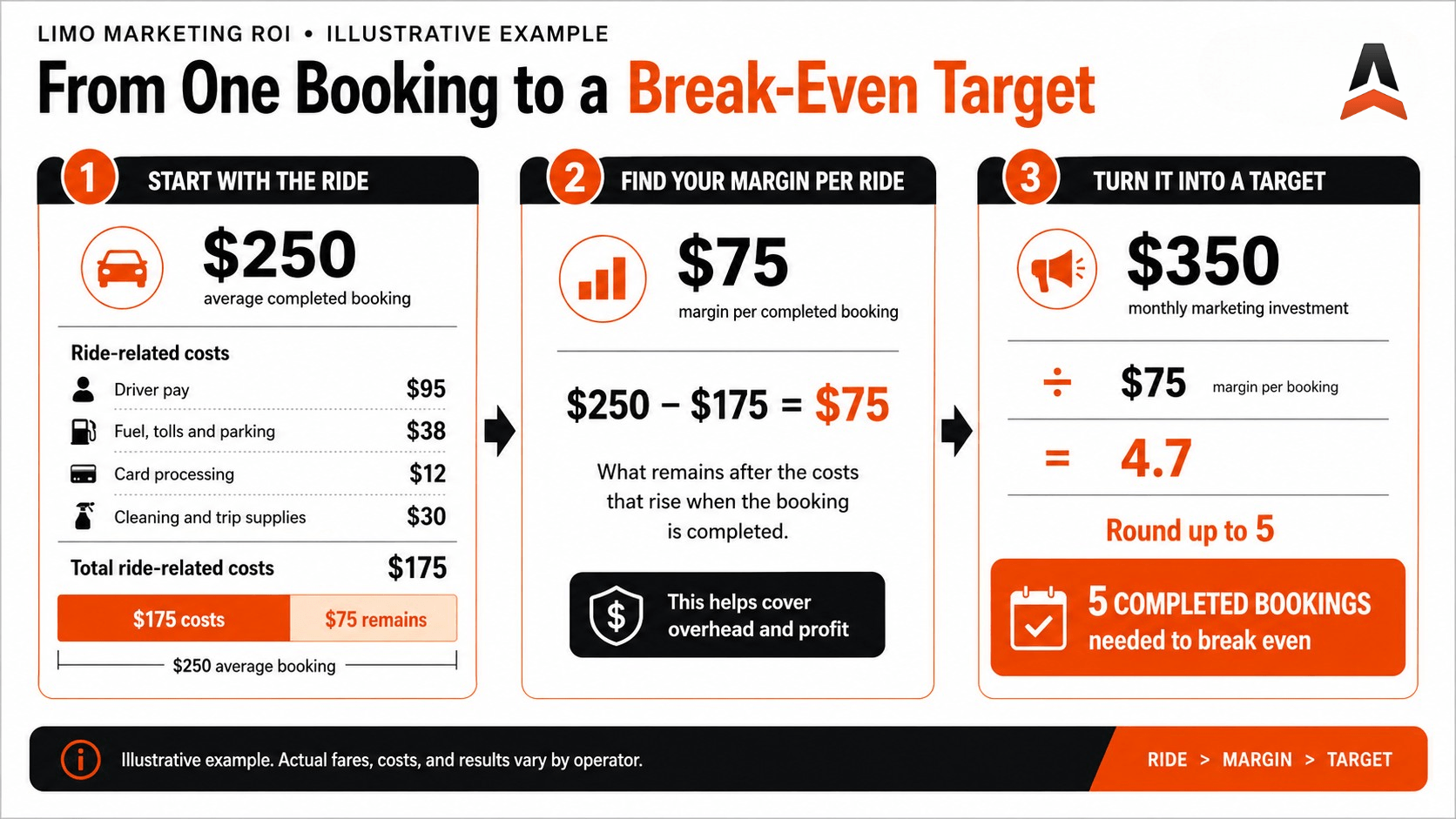
Suppose an average completed booking brings in $250.
The company does not keep all $250. Completing the ride also creates costs such as driver pay, fuel, tolls, card processing, and trip-related supplies. In this illustrative example, those ride-related costs total $175.
| Illustrative booking economics | Per completed booking |
|---|---|
| Average collected booking | $250 |
| Driver pay | −$95 |
| Fuel, tolls, and parking | −$38 |
| Card processing | −$12 |
| Cleaning and trip supplies | −$30 |
| Margin per completed booking | $75 |
The $75 is your margin per ride: the amount left after the costs that rise when the booking is completed. In financial reporting, this is often called contribution margin. For this article, we will use the simpler term margin per ride.
In this example, $75 is 30% of the $250 collected booking. The 30% margin is an illustration, not an industry benchmark. Your actual margin will vary by service type, market, vehicle, driver pay, and operating model.
Calculate the Bookings Needed to Break Even
Suppose, for illustration, a marketing effort costs $350 per month. This is a planning example, not a quoted Limo Anywhere price. At a $75 margin per completed booking:
$350
Total monthly amount being evaluated
$75
Amount left after ride-related costs
5 rides
$350 ÷ $75 = 4.67, rounded up
The marketing would need to produce five incremental completed bookings that would not otherwise have occurred to cover the monthly cost.
Always round up to the next whole booking. A business cannot complete 4.67 rides.
Use the full cost of the effort. Depending on the channel, that may include a management fee, advertising spend, and any recurring tool required for tracking, quoting, or follow-up. Treat a one-time setup fee separately or spread it across the period you plan to evaluate.
Calculate Limo Marketing ROI After the Bookings Arrive
Break-even bookings tell you what the marketing needs to accomplish. Marketing ROI tells you what it actually accomplished.
Suppose the $350 marketing service generates seven additional completed bookings that can reasonably be attributed to the marketing effort:
- 7 bookings × $75 margin per ride = $525 in total margin
- $525 − $350 marketing cost = $175 estimated return
- $175 ÷ $350 = 50% estimated marketing ROI
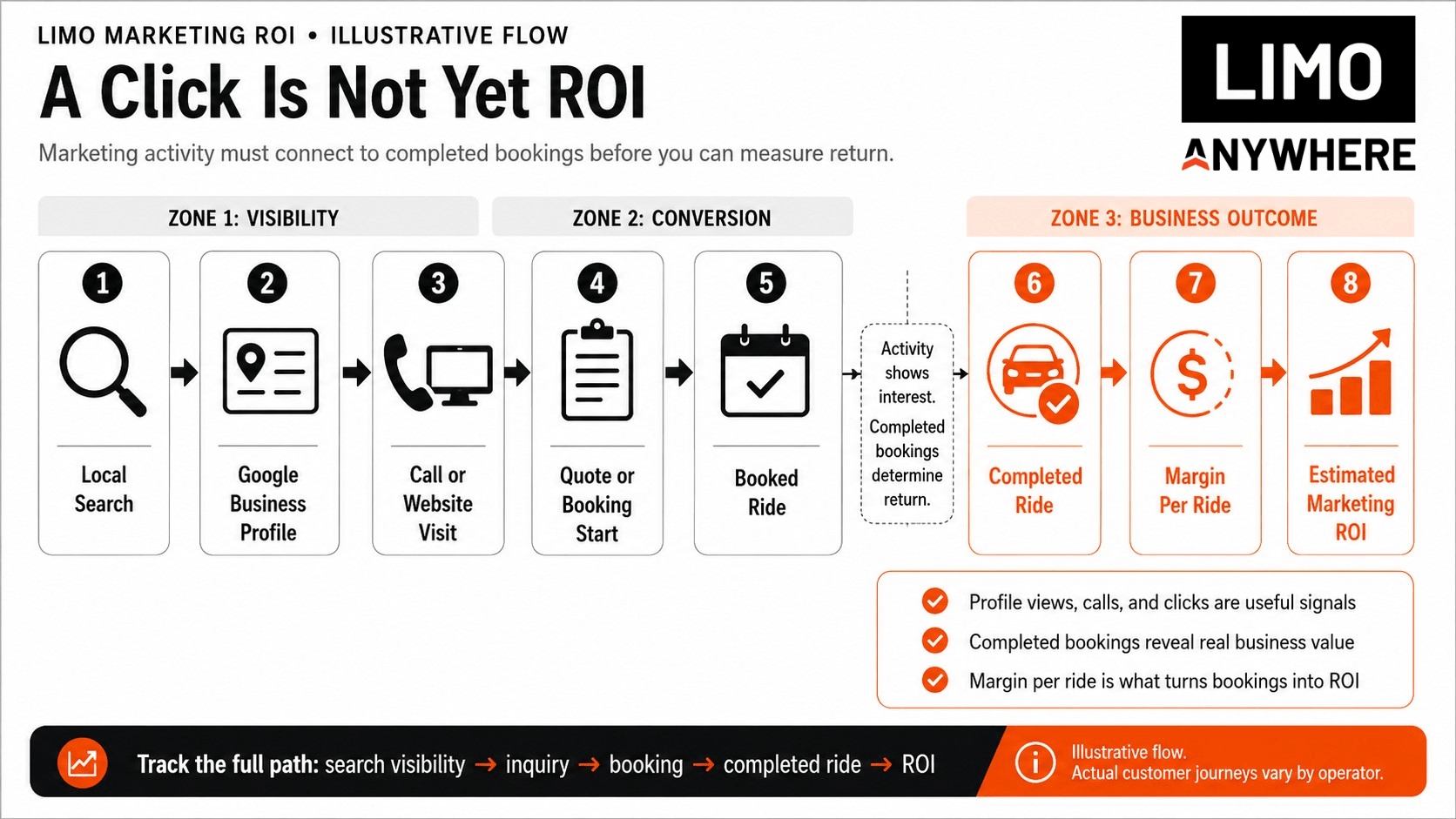
This calculation is only as reliable as the attribution behind it. Calls, clicks, quote requests, and profile views are useful indicators, but they are not completed rides.
Use the Ride Type You Want to Grow
Do not automatically use one average across the entire company.
An airport transfer can have different economics from a wedding, corporate booking, party bus rental, or hourly chauffeur engagement. If the campaign is intended to generate airport work, use airport booking data. If it is intended to generate weddings, use wedding data.
Review at least 90 days of completed bookings. For a highly seasonal service, use a full 12 months or compare the same period from the previous year.
Find the Numbers in Limo Anywhere
| What you need | Where to look |
|---|---|
| Average collected revenue per completed booking | Reports → Sales Revenue Report. Filter by date, the completed or settled statuses your operation uses, and Service Type. |
| Revenue by marketing source | Use the Referral Source filter or the Referral Source report type when referral-source data is consistently recorded. |
| Driver pay per booking | Reports → Driver Payroll Report. |
| A customized analysis | Reports → Reporting & Analytics to build and save a report with the fields and filters you need. |
| Fuel, tolls, parking, processing, affiliate costs, and other ride-related expenses | Fuel-card, toll, merchant, affiliate, commission, and operating records. |
| Repeat booking frequency | Sales Revenue Report by Billing Contact, customer history, or a custom Reporting & Analytics view. |
Only subtract costs that increase when another ride is completed. If a charge is passed through to the customer, use the net amount retained by the company rather than counting the same amount as both revenue and expense.
Limo Marketing ROI & Break-Even Calculator
Update the numbers for the ride type you want to grow. The calculator estimates contribution margin, the completed bookings needed to break even, and—when attributed bookings are entered—estimated marketing ROI.
Planning limitation: This calculator is not a forecast or guarantee. Results depend on the accuracy of the inputs, attribution method, market conditions, conversion process, service quality, and operational capacity. Include costs that rise with added volume.
A Booking and a Customer Are Different Measures
A booking is one transaction. A customer may book repeatedly.
Using the same $75 margin, a corporate customer who completes two bookings per month would produce:
$75 × 24 bookings = $1,800 in estimated annual margin
Use your own customer history rather than an assumed repeat rate. Repeat business improves the longer-term value of a successful acquisition channel, but count that value only after the bookings occur.
Make Sure the Business Can Handle the Demand
The calculation assumes the company can deliver the additional rides without creating costs that have not been entered.
Add Marketing When
- There is unused operational capacity
- Drivers and dispatch can handle additional volume
- Service quality is consistent
- There is a clear break-even target
Address Operations First When
- The team is already overwhelmed
- Calls or bookings are being missed
- Service quality is inconsistent
- Added rides require significant new capacity
If five extra bookings require overtime, another dispatcher, a leased vehicle, or higher farm-out expense, include those costs. When staffing, dispatch, or service consistency is already breaking down, fixing the operating constraint may be the better first investment.
What the Calculation Cannot Tell You
The calculation gives you a threshold. It does not guarantee that a channel or provider will reach it.
Results depend on the market, competition, ride type, reviews, website and booking experience, response time, follow-up, and the company’s ability to complete the work profitably.
Use the calculation to define what success needs to look like. Then use completed-booking data to determine whether the marketing met that standard.
Start With Demand That Already Exists
Different ride types require different marketing approaches. Corporate business is often relationship-driven. Wedding customers may spend more time evaluating photographs, packages, and reviews. Premium chauffeur work frequently depends on reputation and referrals.
For operators seeking more local airport and point-to-point business, Google Business Profile is one of the first channels to evaluate because it appears close to the moment when a customer is searching and deciding whom to contact.
Google explains that local results are mainly based on relevance, distance, and prominence. A complete and accurate profile, customer reviews, and useful photos can help customers evaluate the business, but no provider can purchase or guarantee a specific local ranking.
Google Business Profile performance can show interactions such as calls, website clicks, and direction requests. True ROI still requires connecting those interactions to incremental completed bookings and their margin per ride.
Run your break-even calculation first. Then evaluate whether your local visibility, website, response process, and operational capacity can support the additional bookings required.
Work Out Your Number
Estimate your margin per ride, required completed bookings, and potential marketing return.
See How Local Search Support Works
Learn how an actively managed Google Business Profile can support local discovery and customer trust.
Frequently Asked Questions
Editorial references:
Limo Anywhere Sales Revenue Report · Driver Payroll Report · Reporting & Analytics · Google local ranking guidance · Google Business Profile performance guidance
All financial examples are illustrative planning scenarios, not industry averages, performance claims, or guarantees.