Dynamic Driver Scheduling: A More Structured Way to Plan Drivers, Vehicles, and Trips

Limo Anywhere Black Feature
A driver needs a day off. A vehicle is scheduled for maintenance. A coach reservation requires a driver with the appropriate qualifications. Then several upcoming trips need to be assigned across the remaining team and fleet.
These are normal operating situations. But as an operation adds drivers, vehicle types, service requirements, and trip volume, creating the schedule can become increasingly difficult to manage.
The challenge is no longer simply deciding who should handle one reservation. Dispatch must consider how driver availability, operating permissions, vehicle preferences, vehicle availability, and the complete set of upcoming trips fit together.
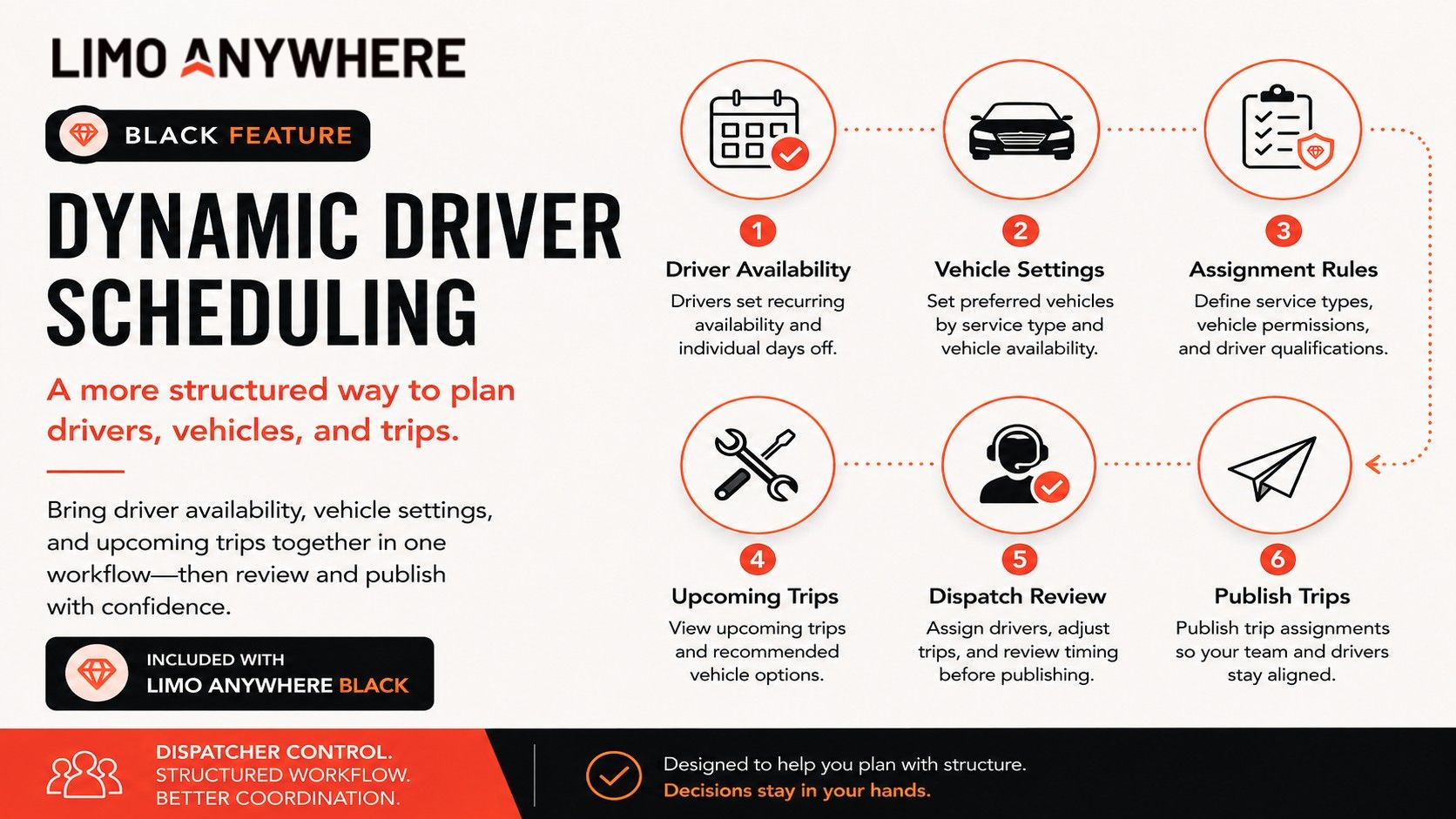
Dynamic Driver Scheduling, included with Limo Anywhere Black, provides a more structured workflow for organizing those decisions. It allows drivers to maintain their availability, gives operators control over driver and vehicle assignment settings, and enables dispatchers to review and publish trip assignments.
Quick Answer
Dynamic Driver Scheduling is an advanced driver-assignment workflow included with Limo Anywhere Black. It brings together the availability, Service Type relationships, vehicle preferences, and vehicle-unavailability settings your team configures so dispatchers can organize trips, adjust assignments, and publish the completed plan.
Dispatch should still review travel time, vehicle positioning, and vehicle-switch timing before assignments are published.
What Is Dynamic Driver Scheduling?
Dynamic Driver Scheduling is an advanced driver-and-vehicle assignment workflow available with Limo Anywhere Black.
The feature brings several parts of the planning process together:
- Driver availability and individual days off
- Vehicle preferences by Service Type
- The Service Types each driver may handle
- The vehicles each driver may operate
- Vehicle unavailability due to maintenance or repairs
- Upcoming driver and vehicle assignments
- Dispatcher review before trips are published
The objective is not to remove dispatchers from the scheduling process. It is to give them a more organized way to prepare and review the plan.
Begin With Driver Availability
A workable schedule begins with knowing who is available.
Authorized drivers can use the mobile web application to enter recurring availability for particular days and times. For example, a chauffeur could indicate that they are normally available from 8:00 a.m. to 7:00 p.m. on selected days of the week.
Drivers can also mark a specific day as unavailable without changing their regular recurring schedule. This gives them a defined way to communicate an individual day off while preserving their normal availability for future weeks.
For an operation that currently collects this information through calls, texts, emails, or separate documents, maintaining availability through a defined scheduling workflow can make the planning process easier to follow.
Reflect the Way Your Operation Assigns Drivers and Vehicles
Availability is only part of an appropriate assignment.
A driver may be available at the required time but not permitted to handle a particular Service Type. A vehicle may be appropriate for one service but not another. Some vehicle classes may also require drivers with specific licenses, endorsements, training, or company authorization.
Dynamic Driver Scheduling allows operators to define those relationships.
Vehicles can be associated with Service Types and arranged according to the operation’s preferences. Specific vehicles can also be connected to services that require them.
Operators can define which Service Types each driver is allowed to handle and which vehicles that driver may operate. The Limo Anywhere setup guide uses appropriately qualified drivers operating buses as one example. A vehicle can also be limited to one driver when needed.
These settings create a more repeatable starting point for scheduling. They do not independently verify a driver’s legal or professional qualifications. Operators remain responsible for confirming licenses, endorsements, training, vehicle suitability, availability, and any applicable regulatory or company requirements.
Keep Unavailable Vehicles Out of the Assignment Process
Vehicle availability can change quickly.
A vehicle may be undergoing maintenance, waiting for a repair, or otherwise unavailable for service. When that status is not reflected in the planning process, dispatch can unintentionally build assignments around capacity the operation does not currently have.
Dynamic Driver Scheduling allows a vehicle to be marked unavailable. While it is unavailable, the system will not assign trips to that vehicle.
This gives dispatchers an opportunity to plan around the vehicles that are actually ready for service before assignments are published.
Organize, Review, and Adjust Upcoming Trips
Once the relevant driver and vehicle settings have been configured, dispatch can begin arranging the upcoming trips.
The initial trip view loads trips according to the operation’s configured vehicle preferences. Dispatchers can then:
- Review the proposed vehicle arrangement
- Move trips to other available vehicles
- View suitable vehicle options
- Assign trips to available drivers
- Adjust assignments to balance the schedule
- Publish trips after the plan has been reviewed
Trips and assignments can be moved using drag-and-drop controls, allowing the dispatcher to refine the plan before it is finalized.
Dispatcher Review Remains Essential
The initial trip view loads according to vehicle preferences
without accounting for travel time.
Dispatchers should review timing, vehicle positioning, required vehicle changes, and other operating realities before publishing assignments.
The scheduling workflow supports dispatcher judgment. It does not replace it.
What Can a More Structured Scheduling Process Improve?
Every transportation operation is different, and no scheduling tool can guarantee a specific labor saving or business result. A more structured planning process can nevertheless help an operation in several practical ways.
Driver availability, vehicle preferences, operating permissions, maintenance status, and trip assignments are interconnected. Managing them through a defined workflow can reduce the need to reconstruct the scheduling picture from several disconnected sources.
A day-off request, unavailable vehicle, or driver-to-vehicle restriction is easier to manage while the plan is being built than after active service has begun.
Defining driver, vehicle, and Service Type relationships can help make scheduling more consistent while preserving dispatcher control.
Recurring availability and individual days off can be maintained through the driver-facing web application rather than communicated differently each time the schedule is created.
Driver Scheduling Versus Dynamic Driver Scheduling
Limo Anywhere Core includes foundational Driver Scheduling, described on the current
Limo Anywhere pricing page
as the ability to schedule drivers and assign trips to them.
Limo Anywhere Black includes all Core and Plus features and adds Dynamic Driver Scheduling as an advanced Driver Assignment tool.
The distinction is not that Core or Plus operators are unable to assign drivers. The difference is the scope of the planning workflow.
Supports the foundational work of scheduling drivers and assigning trips.
- Schedule drivers
- Assign a driver to a trip
- Manage individual trip assignments
Adds a broader planning workflow for coordinating availability, settings, vehicles, and upcoming assignments.
- Consider recurring driver availability
- Define Service Type and vehicle relationships
- Reflect unavailable vehicles
- Review trips across the available team and fleet
- Adjust and publish completed assignments
As an operation adds volume, drivers, vehicle types, and service requirements, that broader workflow can become increasingly valuable.

Has Your Scheduling Process Become an Operational Constraint?
Dynamic Driver Scheduling may be worth exploring when:
Driver availability is maintained outside Limo Anywhere
Days off are communicated through separate calls, texts, or emails
Your fleet includes several vehicle classes
Drivers have different vehicle or service permissions
Maintenance regularly changes available fleet capacity
Trips are repeatedly moved between drivers and vehicles during planning
Important assignment rules depend heavily on one person’s memory
Increasing volume is creating more scheduling coordination work
These situations can indicate that the operation has moved beyond straightforward trip assignment and needs a more structured way to prepare the plan.
Build a Clearer Plan Before Trips Are Published
Growth adds more than reservations.
It adds drivers, vehicles, service requirements, preferences, maintenance considerations, and exceptions. As those elements become more interconnected, the way the operation prepares assignments matters.
Dynamic Driver Scheduling in Limo Anywhere Black gives drivers a way to maintain availability, gives operators control over assignment settings, and gives dispatchers a structured workflow for reviewing and publishing trips.
It does not replace experienced operational judgment.
It gives that judgment a more organized foundation.
Is Limo Anywhere Black the Right Next Step?
Explore Dynamic Driver Scheduling and compare the capabilities available across Limo Anywhere Core, Plus, and Black.
Follow the Dynamic Driver Scheduling setup guide.
Frequently Asked Questions
Is Dynamic Driver Scheduling fully automatic?
Does Dynamic Driver Scheduling account for travel time?
Can drivers enter their own availability?
Can operators control which vehicles a driver may operate?
Can a vehicle be removed from scheduling while it is being repaired?
Which plan includes Dynamic Driver Scheduling?
Recent Posts
Introducing Trip Timeline: See When and Where Each Trip Step Happened
Thursday October 22, 2026
Holiday Taxis Integration
Wednesday October 21, 2026